









logo
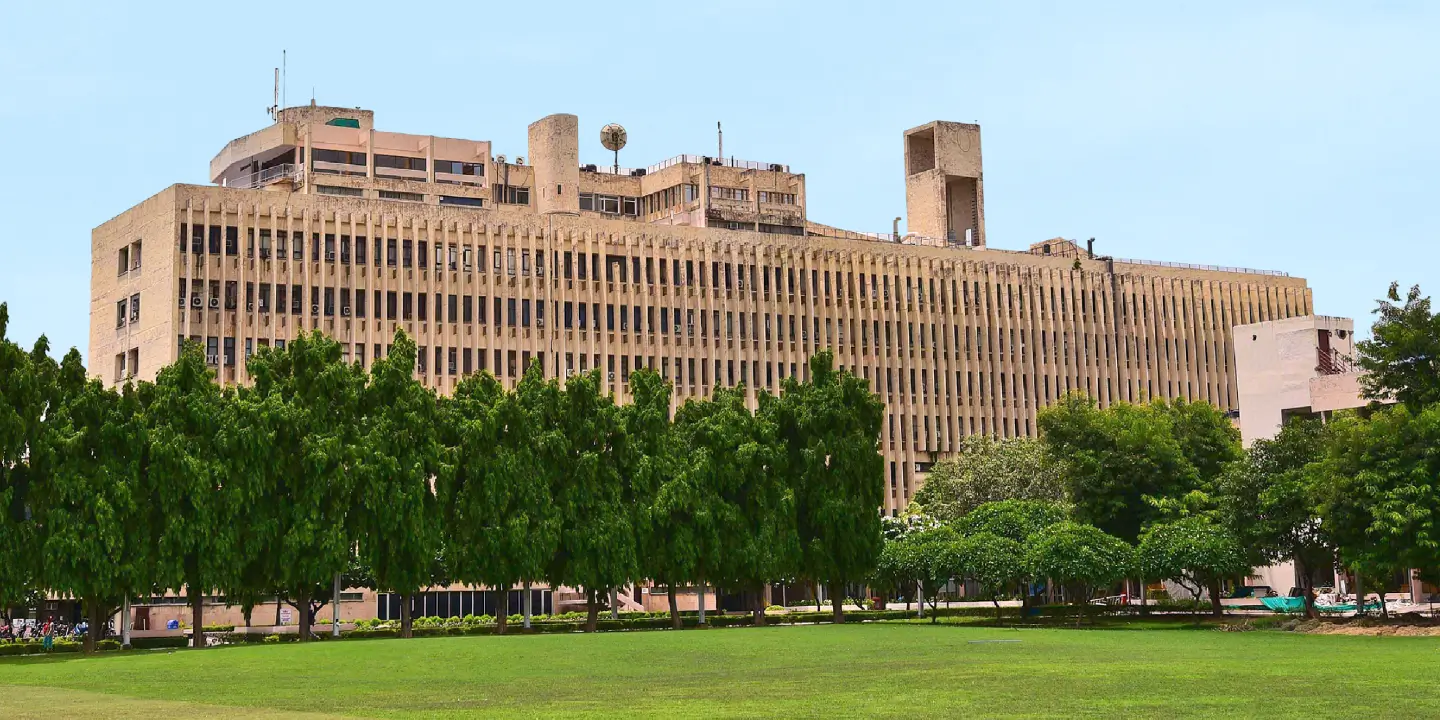
Indian Institute Of Technology Delhi

1st
in QS at World University
Rankings 2024 in India

2nd
in NIRF Ranking
2024 (Engineering)

Programme Starts
28th March, 2026

Programme Fees
₹3,50,000 + GST

Duration
12 Months

Live
Online Session

Programme Overview

In a world driven by innovation, the healthcare industry is constantly evolving—demanding experts who can bridge the gap between scientific breakthroughs and real-world applications. IIT Delhi’s Online PG Diploma in Healthcare Product Development & Management is your opportunity to master the art of bringing healthcare solutions to market.

Read More >

This immersive programme offers a multidisciplinary learning experience, covering biomedical innovation, regulatory science, commercialization strategies, and product management. Taught by IIT Delhi’s esteemed faculty and industry leaders, doing this programme will let you gain hands-on experience through live projects, case discussions, and industry-driven insights.

Whether you are a biotech researcher, healthcare entrepreneur, or regulatory specialist, this programme provides the skills and confidence to excel in healthcare product innovation and management.

Read Less <

Eligibility

Graduates, Postgraduates and Working Professionals with BE/BTech/BCA/BIT in Any Engineering, or equivalent in related areas or basic sciences
OR
BSc or equivalent in Life Sciences and related basic sciences
OR
MBBS, BDS, BPharm or related disciplines
OR
Professionals in Healthcare, Biomedical, Biotech, or related industry with BE/BTech/BSc/ Diploma in Engineering/MBA/MCA

Programme Highlights

Earn prestigious Online PG Diploma from IIT Delhi

Comprehensive Curriculum Covering - biomedical innovation, regulatory frameworks, clinical trials, product lifecycle management, and commercialization strategies

IIT Delhi Affiliate Alumni Status

Hands-on learning with real-world applications

200 hours of live online learning by IIT Delhi faculty

Industry-focused tools for healthcare innovation

Two-day campus immersion at IIT Delhi (optional)

Network with peers & top professionals in the industry

A separate convocation ceremony will be conducted by the organizing department at IIT Delhi

Programme Curriculum

Semester - I

Course 1: Basic Electronics (1 Credit)
  • Fundamentals of Electronics. Electronics components and their principle of operation with respect to medical equipment. Operational amplifiers and their use in biomedical instrumentation. Electronic interfacing of analogue circuits with computer. LabVIEW-based virtual instrumentation. Electronic signal conditioning
  • Learning Outcome:

    Fundamentals of Electronics. Electronics components and their principle of operation with respect to medical equipment. Operational amplifiers and their use in biomedical instrumentation. Electronic interfacing of analogue circuits with computer. LabVIEW-based virtual instrumentation. Electronic signal conditioning. Basics and hands-on learning on mechatronics and their application in the development of healthcare products.

Course 2: Basic Biology and Physiology (1 Credit)
Course 3: Mechanics of Biomaterials (1 Credit)
Course 4: Biofabrication (3 Credit)

Semester - II

Course 5: Research Techniques in Biomedical Engineering (3 Credit)
Course 6: Soft Tissue Characterisation and Applications (4 Credits)
Course 7: Healthcare Wearables Design and Applications (3 Credits)
Course 8: Selected Topics in Biomedical Engineering: Healthcare Entrepreneurship and Management (2 Credits)
Total Credits: 18 credits

DISCLAIMER: Curriculum is subject to change and modification, as per the requirement of the programme. IIT Delhi and Programme Coordinator’s decision will be final.

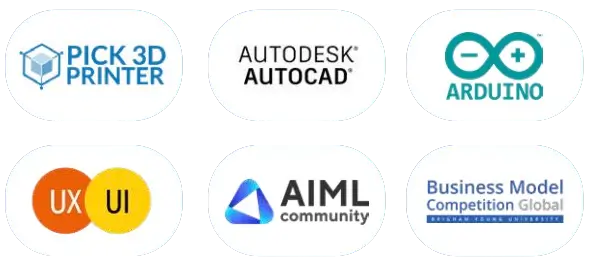
Tools You Will Learn

Key Learning Outcomes

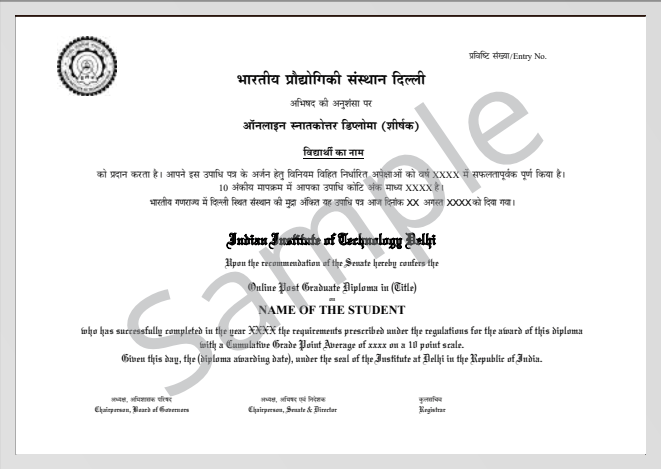
Programme Certificate

Affiliate Alumni Status

To secure the Affiliate Alumni Status, learners will have to pay a one-time, non-refundable, mandatory affiliate alumni membership fee of ₹10,000 + taxes at the time of admission, which is over and above the Programme Fee.

Benefits:

The Affiliate Alumni, with prior approval from the Alumni and Endowment Office, are allowed to visit the IIT Delhi campus as per the Institute visitor's policy.

Disclaimer: *The above Online PG Diploma certificate is for illustrative purpose only, and the format may be changed at the discretion of IIT Delhi.
Online PG Diploma will be issued separately by the organizing department.

Programme Faculty

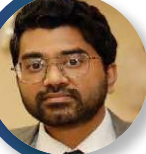
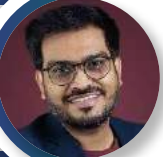
Prof. Arnab Chanda
Associate Professor, Centre for Biomedical Engineering, Indian Institute of Technology Delhi

Prof. Arnab Chanda is an Associate Professor in the Centre for Biomedical Engineering, IIT Delhi. He is also the founder of a start-up company BIOFIT Technologies LLC, USA. He earned his PhD from the University of Alabama, USA and has also been a Postdoctoral Researcher at the University of Pittsburgh, USA. Dr. Chanda is an expert in the area of “Biomechanics”, especially in Tissue Mimicking (Artificial Tissues) and Characterization, finite element modeling (FEM), robotics and wearable device development, and entrepreneurship. To date, he has received Young Researcher Award and Early Career Award from ASME, MHRD, and AO Spine International-Singapore, and Top-Cited Paper Awards from IOP Publishing and Wiley.

He holds and has filed 10+ US and Indian Patents, authored 6 Books and 100+ articles in reputed international journals. Dr. Chanda is in the list of top 2% scientists worldwide as per Scopus Elsevier and Stanford University database in both years 2023 and 2024. He also teaches two successful Executive Programs: “Executive Program in Healthcare Entrepreneurship and Management” and “Executive Program in Robotics”, and multiple Swayam/NPTEL courses to engineers, doctors, and management professionals. Dr. Chanda is serving as the editor for ‘Biomedical Materials for Multi-functional Applications’, a book series published by Springer Nature, editorial board member for Nature Scientific Reports, and guest editor for several journals such as Engineering Research Express, IOP Publishing.

Read More >

Prof. Neetu Singh
Professor and Head of Centre, Centre for Biomedical Engineering, Indian Institute of Technology Delhi

Prof. Neetu Singh’s research focuses on nanomaterials and biomaterials, particularly their biological activity and applications in medicine. She aims to establish design principles for biomedical systems, advancing technologies for targeted therapy and diagnostics.

She obtained her BSc and MSc from the University of Mumbai before pursuing a PhD in Chemistry at Georgia Institute of Technology, Atlanta, under Prof. Andrew Lyon. Her doctoral research focused on developing multifunctional hydrogel nanoparticles through novel synthetic approaches. She then undertook postdoctoral research at the Harvard-MIT Division of Health Sciences and Technology with Prof. Sangeeta Bhatia, where she worked on nanomaterials for RNA therapy.

In 2012, she returned to India as a faculty member in the Polymer Sciences and Engineering Division at NCL, Pune, before joining IIT Delhi in 2014 as an Assistant Professor, later being promoted to Associate Professor in 2019.

Her contributions to cancer research earned her the Kiran Shaw-Mazumdar International Oncology Fellowship to establish research collaborations with MIT, USA. She has also received prestigious awards, including the Innovative Young Biotechnologist Award (2013), NASI-Scopus Young Scientist Award (2019), and Janaki Ammal-National Women Bioscientist Award (2020-21).

Prof. Biswarup Mukherjee
Associate Professor, Centre for Biomedical Engineering, Indian Institute of Technology Delhi

Prof. Biswarup Mukherjee’s research focuses on developing multi-modal platform technologies for non-invasive, real-time monitoring of neuromuscular activity, particularly for rehabilitation applications. His work also includes designing biomimetic sensors to enhance sensorimotor integration in individuals with motor disabilities and developing tools for the quantitative assessment of motor skills.

He earned his PhD in Electrical Engineering from IIT Madras, where he developed capacitive and magnetic sensing systems for medical training and simulation. He later worked as a postdoctoral research fellow at Harvard Medical School, developing innovative medical training models for emergency medicine, ophthalmology, and nursing.

Prof. Mukherjee also served as a Research Assistant Professor in the Department of Bioengineering at George Mason University and was an affiliate faculty member at the Center for Adaptive Systems of Brain-Body Interactions. At Mason, he contributed to multiple federally funded projects, focusing on low-power ultrasound instrumentation and muscle activity monitoring for prosthetic and rehabilitation applications.

Prof. Pradipta Mukherjee
Associate Professor, Centre for Biomedical Engineering, Indian Institute of Technology Delhi

Prof. Pradipta Mukherjee is an Associate Professor in the Centre for Biomedical Engineering, IIT Delhi. His research focuses on biophotonics, an interdisciplinary field combining biomedical engineering and optical sciences. He specialises in developing advanced optical imaging systems, including optical coherence tomography, microscopy, and polarisation-based imaging, to explore the functional dynamics of living tissues. His work aims to advance non-invasive optical imaging techniques to transform healthcare diagnostics and treatment.

He earned his PhD as a Japanese Government MEXT scholar from CORE, Utsunomiya University, Japan, where he developed an epi-illumination Mueller matrix microscope and polarimetric methods for analysing microstructural and mechanical properties of biological tissues. After his doctorate, he pursued postdoctoral research at the Computational Optics Group (COG), University of Tsukuba, Japan, under Prof. Yoshiaki Yasuno, focusing on technological advancements in optical coherence microscopy for studying metabolic diseases.

Prof. Sachin Kumar B
Associate Professor, Centre for Biomedical Engineering, Indian Institute of Technology Delhi

Prof. Sachin Kumar’s research focuses on the interdisciplinary fields of biomaterials, biomechanics, and bio-optics, exploring how the mechanical, chemical, and physical properties of biomaterials influence cellular functions. His work aims to advance understanding in areas such as cancer progression, stem cell differentiation, tissue regeneration, and cellular metabolism.

He earned his undergraduate degree in Biotechnology from M.S. Ramaiah Institute of Technology and pursued a PhD in Biomaterials at the Indian Institute of Science (IISc), Bangalore. Following his doctorate, he was awarded the Humboldt Postdoctoral Fellowship to conduct research at the Max-Planck Institute for Polymer Research (MPIP), Germany. He later continued his postdoctoral research at The University of Texas (UT) at Austin, USA, before joining IIT Delhi in 2021.

Prof. Aarat Kalra
Associate Professor, Centre for Biomedical Engineering, Indian Institute of Technology Delhi

Prof. Aarat Kalra leads the Bioelectronics Research Group. His research explores the electrical basis of life by integrating materials science, electronics, and medicine. His current focus includes investigating the mechanism of electric field-based cancer treatments and exploring how the electronic properties of proteins can be utilised in solar cells and OLEDs (organic light-emitting diodes). His work has significant implications for both medicine, driving the emergence of “electroceuticals” for disease treatment, and nanotechnology, advancing protein-based electronic devices.

Prof. Kalra holds a BSc (Hons.) in Chemistry from Dayalbagh Educational Institute (Agra, India), an MSc in Biology from McGill University, and a PhD in Physics from the University of Alberta, where he worked with Prof. Jack Tuszynski. Following his doctorate, he pursued postdoctoral research in the Department of Chemistry at Princeton University with Prof. Gregory Scholes, publishing pioneering work on microtubule electronics.

His research has earned several prestigious awards and funding. In 2020, he received the Alberta Innovates Graduate Student Scholarship, and in 2021, he was honoured with the Young Systems Scientist Award by the Systems Society of India. In February 2022, he delivered an invited talk at Google on "Is Our Brain a Quantum Computer?". His work on microtubules has also been featured in The New Scientist magazine

Read Less <

Class Schedule

Saturdays
Session: 10:00 AM to 12:00 PM (IST)
Session: 12:30 PM to 02:30 PM (IST)
Sundays
Session: 10:00 AM to 12:00 PM (IST)
Session: 12:30 PM to 02:30 PM (IST)

Programme Fees

₹3,50,000 + GST